 440-965-4332
 Give us a Review

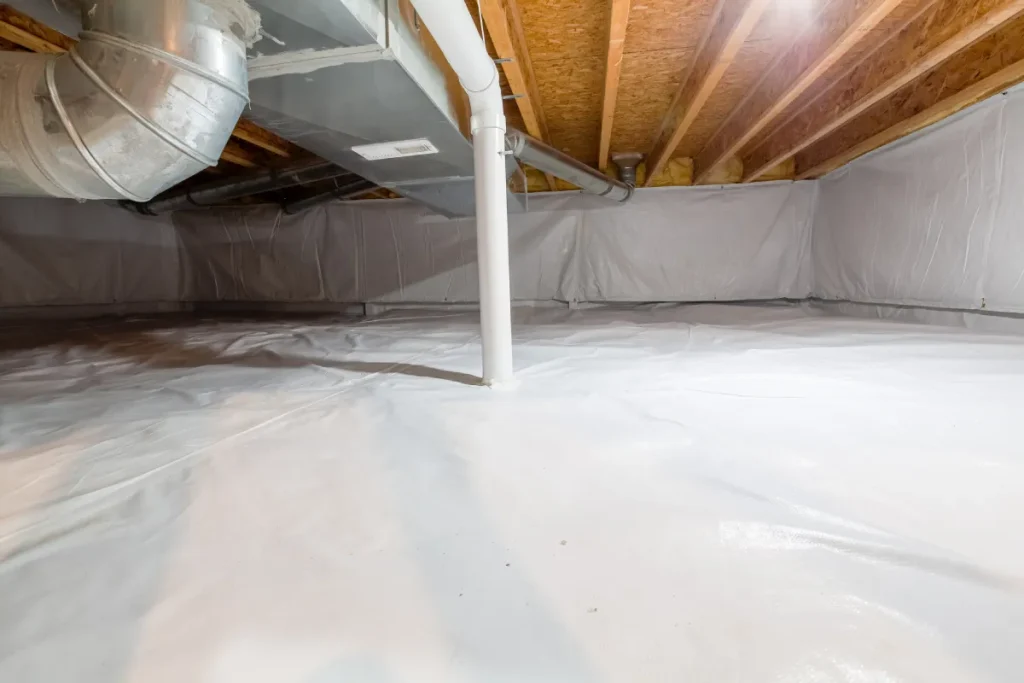
What is a crawl space vapor barrier, and does it stop moisture? A crawl space vapor barrier is polyethylene sheeting laid over the dirt floor to block ground moisture. Building code requires at least 6-mil thickness, but 12-mil to 20-mil reinforced barriers last far longer. A basic barrier does reduce moisture, though full encapsulation with a dehumidifier stops it best. Professional installation typically runs a few hundred to several thousand dollars.
Why crawl space moisture is worse in some regions than others
National averages hide the fact that your local climate largely decides how hard your crawl space works. In humid, freeze-thaw regions like Ohio and the Great Lakes, a bare dirt crawl space is under near-constant moisture pressure, so a vapor barrier is not optional, it is baseline protection.
Here is the underlying problem. The soil under your home is almost never dry. Ground moisture continuously evaporates upward and, without a barrier, migrates straight into the crawl space and the wood framing above it. In Ohio, that pressure is high year-round: the state averages roughly 38.9 inches of precipitation annually, and heavy-rain events have increased substantially in recent decades (Source: NOAA). Add a high water table in many Northern Ohio communities and repeated winter freeze-thaw cycles, and the result is exactly the humid, wood-rotting environment a vapor barrier is designed to prevent.
The U.S. Department of Energy recommends a ground vapor barrier in every crawl space, regardless of climate zone or whether the space is vented (Source: U.S. Department of Energy, Building America). In a wet, cold-winter state, that recommendation is not a maybe.
What thickness of crawl space vapor barrier do you actually need?
Building code sets the floor at 6-mil polyethylene, but for a crawl space anyone will ever enter or that faces real moisture, 12-mil to 20-mil reinforced material is the practical minimum. Thickness is measured in mils (thousandths of an inch), and it drives both durability and how well the barrier resists punctures.
The Department of Energy’s guidance calls for 6-mil or thicker polyethylene that covers the floor and extends up the foundation walls, with seams overlapped and taped (Source: U.S. Department of Energy, Building America). The catch is that plain 6-mil sheeting tears easily. One knee, one dragged toolbox, and the barrier is compromised where you cannot see it.
Here is how the common options compare:
| Thickness | Typical use | Durability | Best for |
|---|---|---|---|
| 6-mil poly | Code-minimum ground cover | Low, tears and punctures easily | Temporary cover, budget vented crawl spaces never entered |
| 10 to 12-mil reinforced | Solid moisture control | Moderate to good | Most homes wanting long-term protection |
| 20-mil reinforced | Full encapsulation liner | High, 20+ years, foot-traffic ready | Encapsulation, spaces used for storage or frequent access |
For a home in a humid, freeze-thaw climate, spending a little more per square foot on a reinforced liner almost always costs less over time than replacing a torn budget barrier.
How much does a crawl space vapor barrier cost?
As a general guide, a basic 6-mil ground cover is inexpensive per square foot, while a professionally installed reinforced barrier or full encapsulation ranges from several hundred to several thousand dollars depending on size, thickness, and scope. Cost depends on a handful of clear factors rather than a single number.
The main cost drivers are:
- Crawl space square footage. Bigger footprint, more material and labor.
- Barrier thickness and quality. Reinforced 12 to 20-mil liners cost more per square foot than plain 6-mil.
- Scope of work. A ground-cover-only barrier is far cheaper than full encapsulation that adds wall liner, sealed seams, insulation, and a dehumidifier.
- Site conditions. Standing water, an active leak, low clearance, or debris removal add labor.
- Extras. Sump pump, drainage, or radon mitigation raise the total but solve the underlying moisture source.
Because those variables swing the price widely, the most reliable number is a free on-site estimate for your specific crawl space rather than a national average.
Does a crawl space vapor barrier actually stop moisture?
A vapor barrier significantly reduces ground moisture, but a barrier alone does not always create a fully dry crawl space. The most reliable moisture control pairs a quality barrier with sealing and a dehumidifier, an approach known as encapsulation. A ground cover stops soil moisture from rising, which is the single biggest source. What it does not do by itself is manage humid outside air entering through vents, or bulk water from a leak or high water table.
That is why the strongest results come from a system, not just a sheet of plastic:
- The barrier blocks moisture rising from the soil.
- Sealing and wall liner cut off humid outside air in an encapsulated (unvented) crawl space.
- A dehumidifier controls the humidity that remains in the sealed space.
- Drainage or a sump pump handles any bulk water from a high water table or leak.
The EPA frames the goal simply: the key to controlling mold is controlling moisture, and covering exposed crawl-space soil with plastic is a recommended step to keep ground moisture out (Source: EPA).
5 factors that determine whether your vapor barrier performs
- Thickness and puncture resistance. A torn 6-mil sheet leaks moisture at every hole. Reinforced 12 to 20-mil liners hold up.
- Full coverage. The barrier must cover 100% of exposed earth. Partial coverage lets moisture in through the gaps.
- Sealed, overlapped seams. Seams should overlap and be taped, and the edges should run up the foundation wall, per DOE guidance (Source: U.S. Department of Energy, Building America).
- A moisture strategy for the air, not just the ground. In a sealed crawl space, a dehumidifier or conditioned air keeps humidity in check.
- Managing bulk water. If a high water table or leak sends liquid water in, the barrier needs drainage or a sump pump behind it to succeed.
Crawl space moisture checklist for homeowners
Use this quick checklist to gauge whether your crawl space needs attention:
- Do you see plastic covering the dirt floor, or is bare soil exposed?
- Is the existing barrier torn, thin, or pulled back from the walls?
- Are the floor joists, sill plates, or subfloor damp, stained, or soft?
- Is there a musty smell in the crawl space or the rooms above it?
- Do you notice sagging insulation, condensation, or visible mold?
- After heavy rain, is there standing water or damp soil?
- Are your energy bills climbing as humid air makes the HVAC work harder?
If you checked several of these, your crawl space is likely losing the moisture battle, and a proper barrier or encapsulation is the fix.
Is a 6-mil vapor barrier good enough?
For most homes that face real moisture or that anyone ever enters, no, 6-mil is not enough on its own. Six-mil polyethylene meets the code minimum, and code minimums exist to be a floor, not a target. Plain 6-mil is thin, often made from recycled plastic, and tears during the normal work of crawling through the space. Every puncture is a spot where ground moisture gets back in.
This is a distinction worth getting right: 6-mil satisfies the inspector, but 12 to 20-mil reinforced material is what actually protects the home over 20 years. Paying once for a durable liner beats paying twice for a cheap one that fails out of sight.
More questions about crawl space vapor barriers
Do I need a vapor barrier if my crawl space has vents?
Yes. Vents address air exchange, not ground moisture. Soil moisture rises continuously regardless of ventilation, so a ground-cover vapor barrier is needed in vented and unvented crawl spaces alike.
What is the difference between a vapor barrier and encapsulation?
A vapor barrier is the ground cover that blocks soil moisture. Encapsulation is the complete system: a heavy liner on the floor and walls, sealed seams, and usually a dehumidifier, which seals the crawl space off from ground and outside moisture entirely.
Can I install a crawl space vapor barrier myself?
A basic ground cover is a manageable DIY project, though the conditions are cramped and dirty. Full encapsulation, wall sealing, and dehumidification, especially where there is standing water or a high water table, are better handled by professionals who can address the moisture source, not just cover it.
Will a vapor barrier get rid of a musty smell?
It helps a great deal, because musty odors come from moisture and mold. Combined with sealing and humidity control, it removes the dampness those odors depend on. EPA notes that controlling moisture is the foundation of mold prevention (Source: EPA).
How long does a crawl space vapor barrier last?
A thin 6-mil cover may degrade or tear within a few years, while a properly installed 20-mil reinforced liner can last 20 years or more. Durability tracks closely with thickness and installation quality.
Does a vapor barrier help with energy bills?
Often, yes. A drier crawl space means the HVAC system works less to condition humid air, and dry insulation keeps its rated performance instead of sagging and losing value.
Key facts to remember
- 6-mil polyethylene is the code-minimum ground cover; 12 to 20-mil reinforced is what performs long term.
- The DOE recommends a ground vapor barrier in every crawl space, vented or not (Source: U.S. Department of Energy, Building America).
- A barrier blocks soil moisture; full encapsulation with a dehumidifier controls it best.
- Ohio’s climate (about 38.9 inches of annual precipitation and rising heavy rain) makes moisture control essential (Source: NOAA).
- Controlling moisture is the key to controlling mold (Source: EPA).
- Cost scales with square footage, thickness, and whether you choose a ground cover or full encapsulation.
Protect your crawl space and the home above it
A dry crawl space protects your floors, your air quality, and your foundation. If you are in Northern Ohio and unsure whether your crawl space needs a new barrier, a repair, or full encapsulation, the team at Daniel’s Waterproofing can help. With over 40 years of experience and more than 20,000 basements and crawl spaces protected across North Central and Northeast Ohio, we install the right crawl space vapor barrier system for your home and back it with a lifetime warranty.
Call 440-965-4332 or contact us for a free estimate. You can also learn more about our full range of crawl space and waterproofing services or read about interior basement waterproofing if moisture has already reached your basement.